

Owner names, mailing addresses, and absentee owners for any parcel in the US – without a county portal, a paid pull, or a title company call.
Every off-market deal starts the same way: you find a property worth pursuing, and then you need to find the person who can actually sell it to you.
That second part is where most outreach campaigns stall. Ownership is public record – it’s not hidden information. But turning “who owns this parcel” into “a name and a mailing address I can actually use” is rarely as simple as it should be, especially at any real volume.
Why Ownership Data Matters
For a developer or investor working off-market, ownership data isn’t a nice-to-have – it’s the starting point. You can’t make an offer on a property you can’t find the owner for. Three things make ownership data valuable before a site is ever listed:
- Direct outreach. A mailing address is what turns a promising parcel into an actual letter, postcard, or cold call – the first step of any off-market campaign.
- Absentee and institutional owners. An owner whose mailing address doesn’t match the property address is a signal worth noticing – it often means the property is investment-held, inherited, or otherwise not owner-occupied, all of which can mean more openness to a conversation.
- Sourcing at scale. Building a real pipeline means identifying dozens or hundreds of candidate owners across an area, not just one parcel at a time.
None of this works without accurate, current ownership data – and getting it has historically been the slow part of the process.
Why It’s Hard the Old Way
The information itself is public. The problem is what it takes to get it into a usable form.
Every county runs its own assessor system, with its own interface, its own update schedule, and its own idea of what to show the public. Some counties list the owner’s name but not their mailing address – which means you can confirm who owns a property without ever learning where to send them anything. Others bury the data behind a search tool that only accepts one APN at a time, making it painful to build a list of more than a handful of properties.
When the county portal doesn’t have what you need, the fallback has usually been a per-record data pull or a title company query – a separate fee and a separate wait, every single time, on top of whatever tools you’re already paying for. It’s not that a paid step is the problem. It’s paying and waiting again for every new batch of owners, instead of that access just being part of what you already have.
And even then, what usually comes back is a name and, if you’re lucky, a mailing address – not a phone number or an email you can actually use to start a conversation. Getting an owner on the phone has historically meant yet another separate step: a skip-tracing service, layered on top of the pull you already paid for, with its own fee and its own wait.
For a developer working across multiple counties or states, this isn’t a one-time cost. It’s a repeated one – a different portal, a different format, and a different set of gaps for every jurisdiction.
Can General AI Find Property Ownership?
Developers increasingly try ChatGPT, Claude, or Gemini for exactly this kind of question. These tools are genuinely useful for a lot of real estate research – just not this part of it.
General AI can:
- Explain what an absentee owner or a private trust structure typically means
- Describe how a title search or skip-tracing process generally works
- Reason through an outreach scenario you describe to it
General AI cannot:
- Tell you who owns a specific parcel right now
- Give you that owner’s mailing address
- Tell you whether the mailing address differs from the site address – the actual absentee-owner signal
- Confirm ownership type – trust, LLC, government-owned – for a real address
- Generate a list of every owner within a drawn area or a radius
The gap is live data. A general AI model draws on its training data – it has never seen the county recorder’s database, and it never will in real time, for the parcel you’re asking about. Ask it who owns a specific address, and the honest answer is that it doesn’t know. It can describe what ownership records typically look like. It can’t tell you what’s true for that address, today. That’s the gap a purpose-built tool is built to close.
How Archiwise Surfaces Ownership Instantly
The Ownership Tab
The Ownership tab in Archiwise shows the owner name, ownership type, and mailing address for any parcel in the US, the moment you click it – including cases where the mailing address is different from the site address, which is exactly the absentee-owner signal that matters for outreach.
Every parcel also shows a hold period – how long the current owner has held the property – paired with a Sell Candidate rating that scales with it: a longer hold tends to carry a stronger rating, up to Very Strong Sell Candidate on properties held the longest.
Contact details are available by clicking the Load Owner Contacts button that appears below the ownership summary. Name, entity type, mailing address, and hold period are visible the moment you open the tab; phone or email, where available, appear once you click that button.
Example 1- Very Strong Sell Candidate: 17354 Stagg St
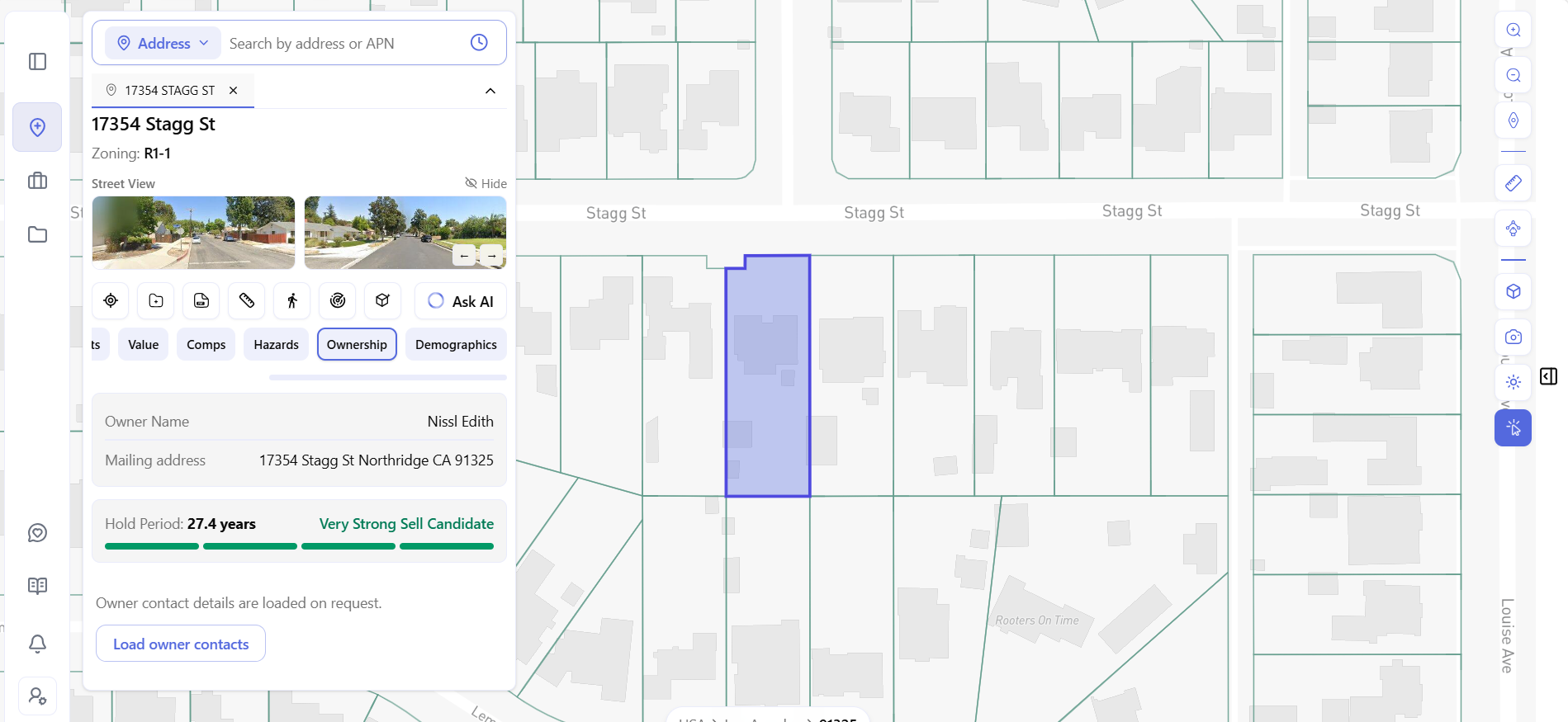
17354 Stagg St, Northridge- zoning R1-1. Open the Ownership tab and the picture is immediate:
- Owner Name: Nissl Edith
- Mailing address: 17354 Stagg St, Northridge, CA 91325
- Hold Period: 27.4 years- flagged Very Strong Sell Candidate
Twenty-seven years in the same hands. The platform’s own rating is already stacked on top the moment you look – no spreadsheet, no separate scoring step. A hold period this long is a conversation worth having. The Load Owner Contacts button sits right below the hold-period bar, ready when you are.
Example 2- Weak Sell Candidate: 17449 Keswick St
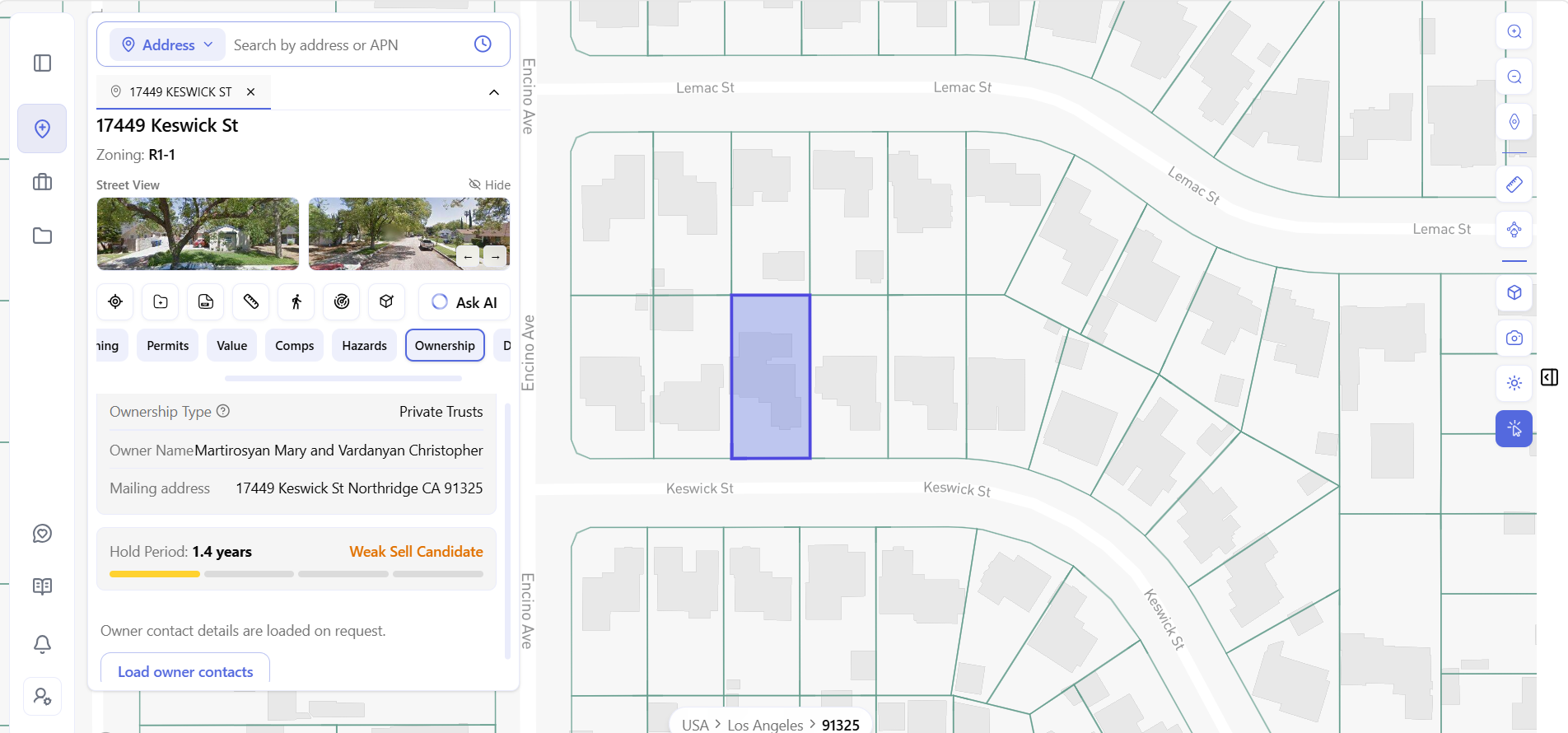
Now compare that to 17449 Keswick St, also zoning R1-1- same ownership type, Private Trusts, but everything else about the picture is the opposite:
- Owner Name: Martirosyan Mary and Vardanyan Christopher
- Mailing address: 17449 Keswick St, Northridge, CA 91325- the same address as the property
- Hold Period: 1.4 years- flagged Weak Sell Candidate
A hold period measured in months, not decades. The platform’s rating lands at the opposite end of the scale – Weak Sell Candidate. But the contact details are still there if you need them.
Clicking Load Owner Contacts
Click Load Owner Contacts and the full contact picture appears – phone numbers and email addresses for the people behind the ownership record, where available. Not just a name on a mailing label, but the actual contact details behind it – the exact step that used to mean hiring a separate skip-tracing service, paying a separate fee, and waiting on results that might not even come back current.
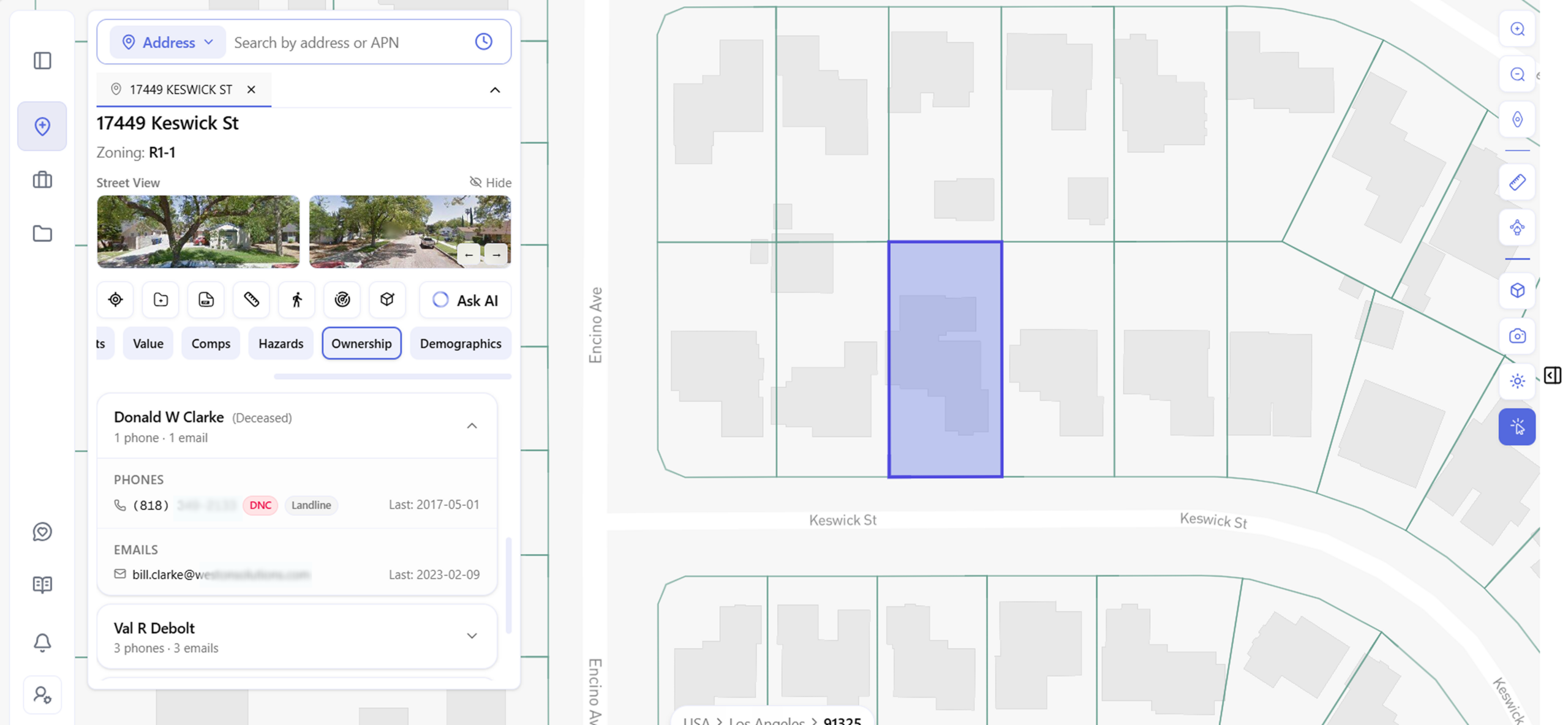
Real phone numbers and email addresses – not a name on a mailing label. The step that used to be a separate skip-trace is now the same click as opening the tab.
Filtering an Entire Area
The Ownership tab covers a single parcel. For sourcing at scale, open the filter panel, set your ownership criteria, and the map updates instantly- showing only matching parcels across whatever is currently visible on screen. Filter by zip code or city to target a specific market, or draw a custom area if you prefer.
You can filter by Government-owned parcels directly, or open the Ownership Type field and choose from the full checklist of numbered codes- giving you precise control over exactly which kinds of owners you’re targeting.
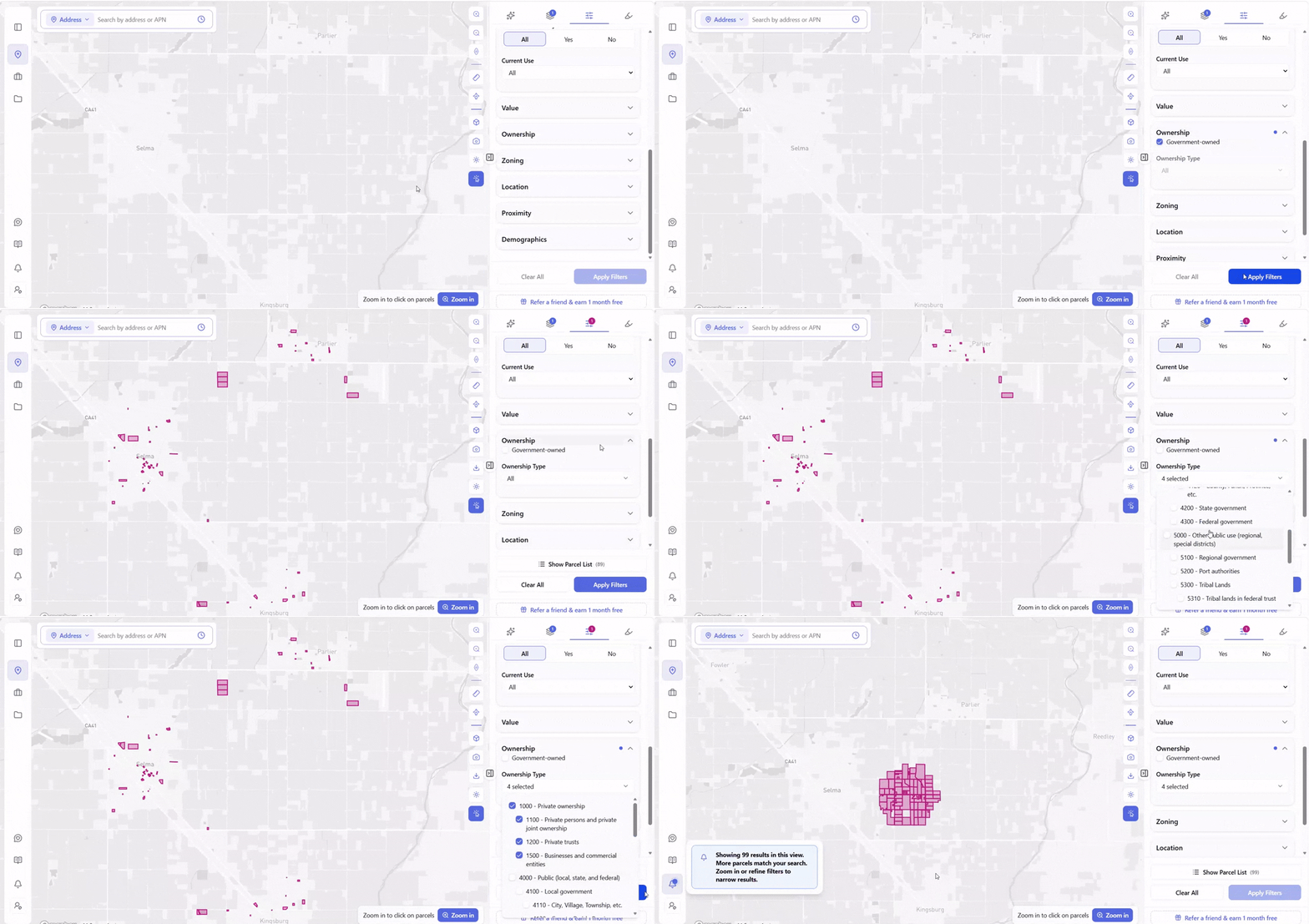
You can filter directly by Government-owned parcels, or open the Ownership Type field and choose from the full checklist of numbered codes: The Ownership Type field expands into a full checklist of numbered ownership-type codes: For example: 1000 – Private ownership, 1100 – Private persons and private joint ownership, 1200 – Private trusts, 1500 – Businesses and commercial entities, further down 5330 – Tribal allotted land in federal trust, 6000 through 6400 for nonprofit ownership by subtype, then 7000 – Joint ownership (public entities) and 8000 – Joint ownership (public, private, nonprofit). Real codes, not just category labels- the kind of granularity a manual, county-by-county search would never surface consistently.
Select the ownership types that match your criteria and the filter narrows the current map view instantly down to only the matching parcels. That’s the real off-market advantage: not just finding out who owns one parcel, but filtering an entire area down to the owners actually worth reaching out to first.
The Radius Map
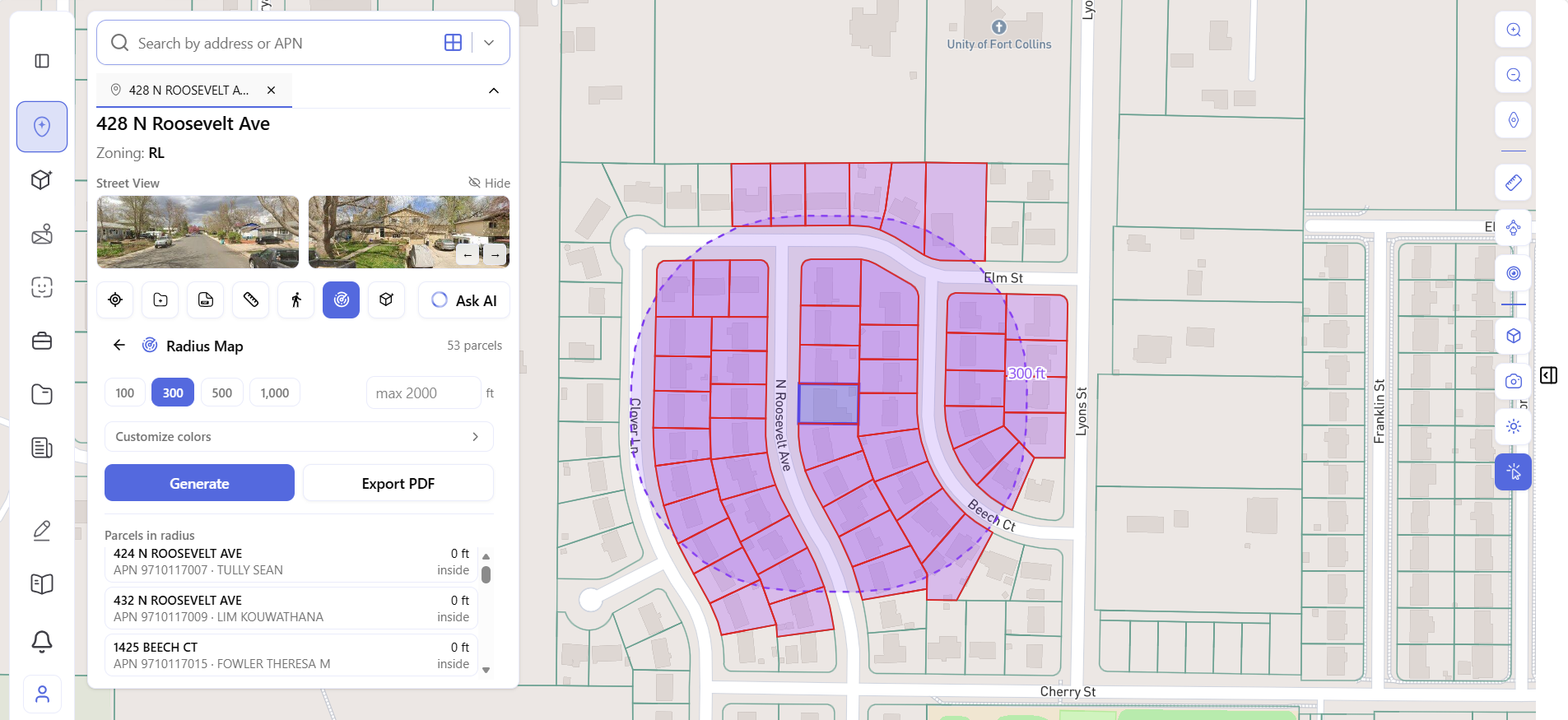
There’s a third place ownership data shows up, built for a different reason but useful for the same one: the Radius Map tool. It exists to meet a legal requirement – most jurisdictions require notifying every property owner within a set distance before a conditional use permit, variance, or zone change hearing – so the exported report already includes a complete ownership table: legal owner name and mailing address for every parcel within the radius, not just the subject property.
Take 428 N Roosevelt Ave in Fort Collins, Colorado, zoned RL. Generate a 300 ft radius, and the tool instantly returns every parcel within that distance- each listed with its address, APN, and owner name. Built to satisfy a hearing notice requirement, but it reads exactly like an instant prospecting list for every owner around a site worth watching.
Worth being straightforward about: ownership records reflect what’s recorded with the county, which can lag behind a very recent sale, and an LLC or trust name doesn’t always tell you who’s actually making the decision on the other end. Archiwise gets you the accurate starting point – the name, the entity type, the mailing address – fast enough that outreach becomes a same-day task instead of a week of portal-hopping. It doesn’t replace the conversation that comes after.
The Bottom Line
Ownership was never the part of the deal that should take the longest. Archiwise turns it back into what it should be – a name, a mailing address, and an ownership type, in seconds, for one parcel or a whole area at once. That’s not a shortcut around due diligence. It’s just a faster way to know who to call.
Find out who owns your next site – and how to reach them.
Learn more
ArchiWise helps developers, investors, architects, and brokers go from address to decision in minutes, not weeks.
Whether you’re screening sites for multifamily development, evaluating zoning constraints, surfacing incentive eligibility like QCT and LIHTC, or assessing hazard risk before committing capital, ArchiWise runs every layer of analysis in one place.
Explore how ArchiWise helps teams screen development sites, analyze zoning, and make confident go/no-go decisions faster.